


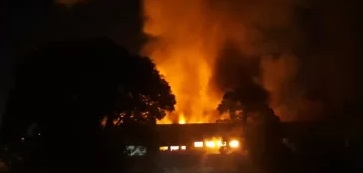
Have you ever wondered how much we’d lose if there was a large fire?
Resposta rapida
Toolbox Talk – Fire Prevention: What can you do with fire?: Para Toolbox Talk – Fire Prevention: What can you do with fire?, comece pelo objetivo, revise os pontos criticos e use a tabela como checklist antes de executar.
Resumo em tabela
| Aspecto | Como aplicar | Por que importa |
|---|---|---|
| Objetivo | Entender o que precisa ser feito antes de agir. | Evita aplicacao fora de contexto. |
| Criterio | Separar pontos de atencao, requisitos e limites. | Ajuda a tomar decisoes mais consistentes. |
| Execucao | Aplicar em etapas e registrar o que foi feito. | Reduz erros e facilita revisao. |
| Revisao | Conferir resultado e corrigir desvios. | Mantem o conteudo util no uso real. |
If our facilities are damaged, some of us may lose our jobs or even our lives as a result.
Because customers trust our products, they don’t realize they’re missing out by not advertising their prices. Some companies may have to downsize or even lay off employees as a result of this. This leads to a never-ending cycle.
What can you do with fire?
We need to know the basics in order to coordinate our fire efforts.
Any fire requires three basic components. They are carbon, oxygen and fuel.
Anything that can be used to fuel a project: wood, paper, oil and so on.
The degree of heat necessary to evaporate any fuel depends on the fuel’s nature.
In order to sustain a fire, a minimum of 15% air is required.
Increasing the concentration increases the brightness of the flames and the rate at which they burn. This can be accomplished by doing one of the following:
Keeping food cold (temperature control)
In order to control oxygen levels, Asphyxia is used.
Control isolation by means of fuel.
Certain fires can break the chemical chain reaction thanks to an interruption in the chemical reaction.
Fires are classified according to the materials they burn.
Tools in the Fire Prevention box provide information on preventing fires.
In addition to the Four Reasons to Work Safely, there are five additional reasons.
In order to understand basic types of fall protection, it’s important to first learn safety toolbox talk. This is how workers identify and describe the different tools they use to get back on their feet safely.
Toolshed Dialogue refers to the in-game text referring to a close talker who talks about fire prevention.
Before starting work, employees should understand the importance of using safety talks as a management tool. They also serve as a teaching tool.
This is intended as a theoretical front for a service. Because of this, all Safety Talks must be generic so that people can adapt them to their work front. This is because the HSE professional, the company or sector leaders on safety, and environment must adapt these talks to their realities. Safety Talks must only be conducted by the person who will be performing the act on the work front.
Talking about safety makes the Safety ToolBox useful.
Perguntas frequentes
Para quem este guia e indicado?
Para quem precisa de uma explicacao pratica, organizada e facil de consultar antes de aplicar o tema.
Como usar melhor este conteudo?
Comece pela resposta rapida e pela tabela, depois leia as secoes de detalhes e perguntas frequentes.
Posso adaptar as orientacoes?
Sim, desde que a adaptacao preserve o objetivo, os criterios e os cuidados principais apresentados.
Leia tambem
- Toolbox Talk – Noise Control at Work: Why Your Hearing is Worth More Than Gold
- Toolbox Talk – Safety with Power Tools: How Not to Become a Work Statistic
- Toolbox Talk – The Great Battle of Masks: PFF2, N95, KN95 – What’s the Real Difference?
- Safety Toolbox Talk – Form F-SMS-001: The Essential Tool for Safety Training Control
- Guias e Temas Principais
Guia central: veja tambem Guias e Temas Principais.


Conteudos relacionados
Environmental Incident Reporting: What Every Site Should Track
Most environmental compliance failures do not start with a major spill or a dramatic release. They start with…
Confined Space Entry: Key Hazards and Safety Precautions
Confined space work remains one of the leading causes of severe and fatal injuries in industrial and construction…

Emergency response Plan: Controls, Records and Follow-up
This article was created to strengthen the Environment category and expand the editorial coverage of workplace safety, health…

Workplace health Guide: Practical Steps for Safety
This article was created to strengthen the Safety category and expand the editorial coverage of workplace safety, health…