
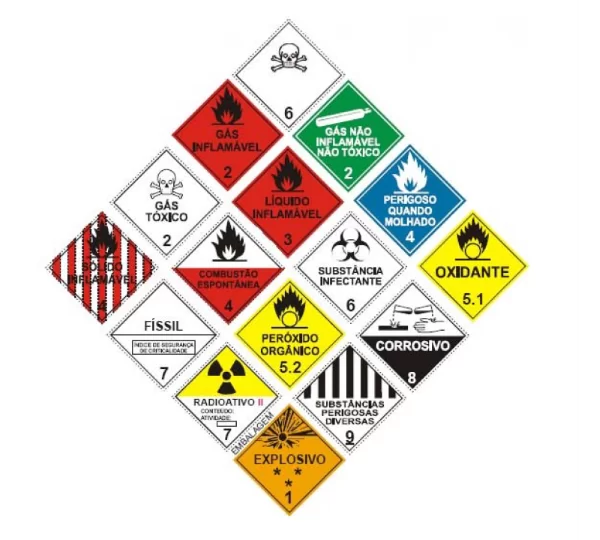
Environmental Risks and Damage – All dangerous goods have their physical-chemical characteristics, which produce: EXPLOSIVE, FLAMMABLE, TOXIC, OXIDIZING and RADIOACTIVE.
Resposta rapida
Environmental Risks and Damage – Toolbox Talk: Para Environmental Risks and Damage – Toolbox Talk, comece pelo objetivo, revise os pontos criticos e use a tabela como checklist antes de executar.
Resumo em tabela
| Aspecto | Como aplicar | Por que importa |
|---|---|---|
| Objetivo | Entender o que precisa ser feito antes de agir. | Evita aplicacao fora de contexto. |
| Criterio | Separar pontos de atencao, requisitos e limites. | Ajuda a tomar decisoes mais consistentes. |
| Execucao | Aplicar em etapas e registrar o que foi feito. | Reduz erros e facilita revisao. |
| Revisao | Conferir resultado e corrigir desvios. | Mantem o conteudo util no uso real. |
The danger is related to the state of the product, the risk control measures and the quantities transported. The greater the safety conditions and the greater the knowledge of the employees about the product, as well as the measures to be adopted in case of emergency, the lesser the potential for danger. The risks that basically polarize people’s attention are due to the FLAMMABILITY of dangerous products.
Substances (including mixtures and solutions) and articles subject to this Regulation are allocated to one of nine classes according to the risk or the most serious of the risks they present. Some of these classes are subdivided into subclasses. However, the classification and definition of the classes of dangerous products, as well as the quantities, gaseous concentrations and degree of explosiveness must be considered:
CLASS 1 – EXPLOSIVES
Subclass 1.1: Substances and articles with a mass explosion hazard
Subclass 1.2: Substances and articles with a projection hazard but not a mass explosion hazard.
Subclass 1.3: Substances and articles with a fire hazard and a small explosion or projection hazard, or both, but not a mass explosion hazard.
Subclass 1.4: Substances and articles that do not present a significant risk
Subclass 1.5: Very insensitive substances with a mass explosion hazard
Subclass 1.6: Extremely insensitive articles with no mass explosion hazard
CLASS 2 – COMPRESSED, LIQUEFIED, DISSOLVED UNDER PRESSURE OR HIGHLY REFRIGERATED GASES
Subclass 2.1: Flammable gases
Subclass 2.2: Non-flammable, non-toxic gases
Subclass 2.3: Toxic gases
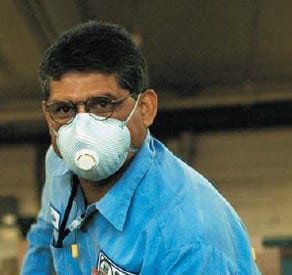
CLASS 3-FLAMMABLE LIQUIDS
RISK GROUP I- Flammable liquids with flash point
below 23°C in a closed vessel and initial boiling point below or equal to 35°C.
RISK GROUP II – Flammable liquids with a flash point below 23°C in a closed vessel, but with a boiling point greater than 35°C.
RISK GROUP III – Flammable liquids with a flash point equal to or greater than 23°C to 60.5°C in a closed vessel with an initial boiling point greater than 35°C.
CONCLUSION – The lower the flash point, the greater the risk of emitting flammable vapors.
CLASS 4- FLAMMABLE SOLIDS; SUBSTANCES SUBJECT TO SPONTANEOUS COMBUSTION; SUBSTANCES
WHICH, IN CONTACT WITH WATER, EMIT FLAMMABLE GASES
Flammable solids; substances subject to spontaneous combustion;
Substances which, in contact with water, emit flammable gases
Subclass 4.1: Flammable solids, self-reactive substances
and desensitized solid explosives
Subclass 4.2: Substances subject to spontaneous combustion
Subclass 4.3: Substances which, in contact with water, emit
flammable gases
CLASS 5 – OXIDIZING SUBSTANCES; PEROXIDES ORGANIC
SUBCLASS 5.1 – Oxidizing substances.
SUBCLASS 5.2- Organic peroxides.
CLASS 6 – INFECTING SUBSTANCES
SUBCLASS 6.1 – Toxic substances: cause death or damage to health in case of ingestion, inhalation or skin contact.
SUBCLASS 6.2 – Infectious substance.
CLASS 7- RADIOACTIVE SUBSTANCES
CLASS 8 – CORROSIVES
GROUP I – Up to 3 minutes: skin necrosis (VERY DANGEROUS).
GROUP II – Causes visible skin necrosis after a contact period of more than 3 minutes but not longer than 60 minutes
(MEDIUM RISK).
GROUP III – Contact period of less than 4 hours (LOWER RISK SUBSTANCES).
CLASSE 9 – SUBSTÂNCIAS PERIGOSAS DIVERSAS
Safety Toolbox Talk: Five Reasons to Work Safely
Safety Toolbox Talk: Fall Protection — Basic Types
Perguntas frequentes
Para quem este guia e indicado?
Para quem precisa de uma explicacao pratica, organizada e facil de consultar antes de aplicar o tema.
Como usar melhor este conteudo?
Comece pela resposta rapida e pela tabela, depois leia as secoes de detalhes e perguntas frequentes.
Posso adaptar as orientacoes?
Sim, desde que a adaptacao preserve o objetivo, os criterios e os cuidados principais apresentados.
Leia tambem
- Toolbox Talk – Workplace Exercise: 🎯 OBJECTIVE
- Toolbox Talk – Water Pollution – Our Environmental Responsibility
- Taking care of the environment is everyone’s responsibility: Preserving the environment is everyone’s…
- The Importance of Waste Recycling: Promoting a Sustainable Future
- Guias e Temas Principais
Guia central: veja tambem Guias e Temas Principais.

Conteudos relacionados
Emergency response Plan: Controls, Records and Follow-up
This article was created to strengthen the Environment category and expand the editorial coverage of workplace safety, health…
Risk assessment Toolbox Guide for Supervisors and Teams
This article was created to strengthen the Environment category and expand the editorial coverage of workplace safety, health…

Training record Checklist: What to Verify Before You Start
This article was created to strengthen the Environment category and expand the editorial coverage of workplace safety, health…

How to Improve Environmental safety with a Simple Field Routine
This article was created to strengthen the Environment category and expand the editorial coverage of workplace safety, health…